
.png)
In the behavioral health industry, the phrase "there’s an app for that" has become a double-edged sword. Every year, dozens of new behavioral health software solutions hit the market, each promising to revolutionize patient care and streamline operations. Yet, if you walk into the average treatment center, you’ll likely find a staff that feels burdened, not bolstered, by their technology.
The reality is that most software for rehabs fails because it is built by developers who understand code, but don't understand the chaotic, high-pressure environment of a residential or outpatient facility. When software feels like "one more thing to do" rather than a tool that disappears into the workflow, it has already failed.
At Team Recovery, we believe that the best software isn't defined by a long list of features, but by how it supports the human connection at the heart of recovery. Here is a breakdown of what actually makes software work for rehab centers—and why most traditional platforms miss the mark.
1. The "Feature Fatigue" Trap
Most CEOs and Clinical Directors start their search by looking for a rehab CRM software or an EHR for addiction treatment with the most "bells and whistles." They want every report, every toggle, and every integration imaginable.
Why this fails: Complexity is the enemy of compliance. If a therapist has to click through seven screens to log a simple patient interaction, they will eventually stop doing it—or they will do it poorly. This leads to "dirty data," which makes your outcome tracking useless.
What actually matters: A "low-friction" interface. High-performing software prioritizes the 20% of features that your staff uses 80% of the time. This is why Team Recovery’s white-labeled app focuses on a mobile-first, intuitive design that mimics the apps your staff and patients already use in their daily lives.
2. Integration vs. Interruption
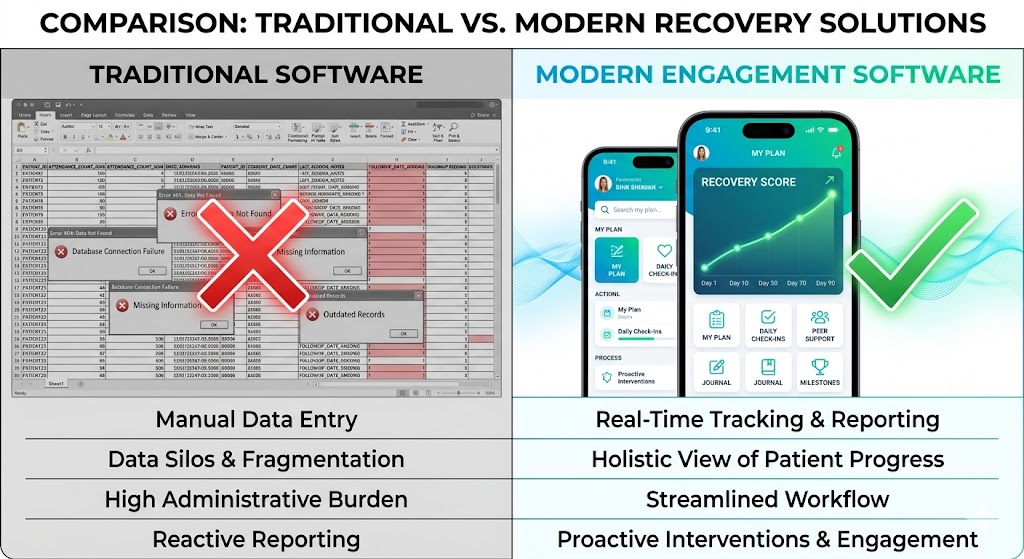
Many centers struggle with "software fragmentation." They have one system for billing, another for their EHR for addiction treatment, and a third for alumni engagement.
Why this fails: When systems don't talk to each other, your staff becomes the "manual bridge" between them, wasting hours on double-data entry. Furthermore, a lack of integration means you lose the "Golden Thread" of a patient’s journey—from the first lead in your rehab CRM software to their five-year sobriety milestone.
What actually matters: Deep, bi-directional integrations. This ensures that patient data flows seamlessly between clinical records and engagement tools, allowing your team to focus on the patient, not the spreadsheet.
3. The "Outcome Gap" in Behavioral Health
Traditional addiction treatment software is great at recording what happened (billing and notes), but it is notoriously bad at predicting what will happen.
Why this fails: Insurance payers are increasingly moving toward value-based care. If you cannot prove with hard data that your program improves long-term outcomes, your reimbursement rates will eventually stagnate. Most software tracks "inputs" (how many sessions did the patient attend?) rather than "impacts" (is the patient still sober six months later?).
What actually matters: Automated outcome tracking and gamification. To get real data, you need patients to want to engage. By using gamification and leaderboards, you turn "data collection" into a community-building exercise. This provides the data you need to negotiate higher rates with payers and satisfy Joint Commission or CARF accreditation requirements.
4. Scalability Beyond the "Admin" Desk
Many behavioral health software solutions are designed solely for the administrator. They are tools for the boss to watch the employees.
Why this fails: Recovery happens in the community, not in the back office. If your software doesn't provide value directly to the patient and the alumni, it is only solving half the problem. An app that sits on a patient's phone creates a 24/7 connection to the center, which is vital during the "danger zones" of early post-discharge.
What actually matters: Brand ownership. A white-labeled solution—meaning the app has your center’s name and logo on the App Store—builds brand loyalty. It tells the patient that they belong to your community, not just a generic software platform.
5. Security and HIPAA: The Non-Negotiable Floor
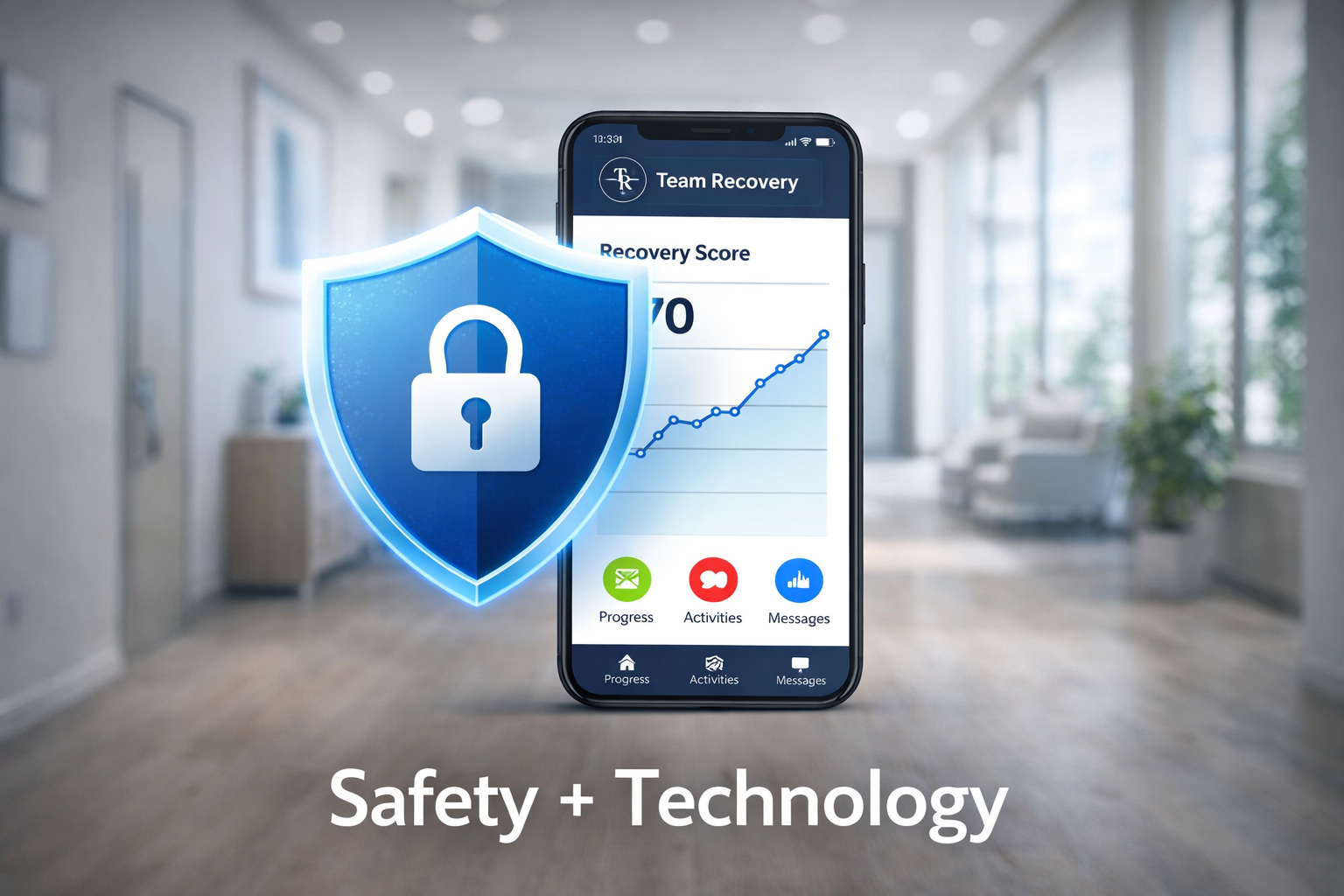
It goes without saying that any software for rehabs must be HIPAA compliant. However, in 2026, compliance is just the baseline.
Why this fails: Generic communication apps (like WhatsApp or Slack) are often used by alumni coordinators because they are "easy," but they are a massive liability. One data breach can result in hefty OCR fines and irreparable brand damage.
What actually matters: A dedicated, secure environment that feels as easy as social media but meets the highest medical security standards. Your behavioral health software solutions should include an SOS button and real-time support features that are both secure and instantaneous.
Conclusion: Investing in Connection
When choosing software for rehabs, stop looking at the feature list. Instead, ask your team: Will this make our jobs more human? Will this keep our patients connected to us for longer?
The future of behavioral health isn't in better spreadsheets; it’s in better engagement. By choosing a platform that prioritizes the user experience and integrates clinical data with community connection, you aren't just buying software—you are investing in the long-term success of your patients.
If you’re ready to see what a community-first platform looks like, get an estimate today or book a demo to see how Team Recovery can transform your alumni management.

Henna Geronimo
Reviewer
Henna is a content strategist with over 5 years of experience. She specializes in creating informed, compassionate content for addiction treatment centers, using her deep understanding of the industry to educate, engage, and support individuals seeking recovery.
.webp)
.png)
.webp)